
|
Home | ||
Amber Fort |
|
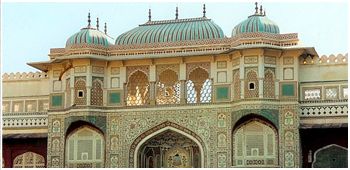 Amber Fort is located in Amber (Jaipur), which used to be the capital of the Kachhwaha clan, till Jaipur was made the official capital in 1727. The Amber Fort looks stunning, all-built in white marble and red sandstone. To add to its charm, Maotha Lake makes its foreground. The crystal mirror image of the Fort, on the still waters of the lake, seems to be a beautiful illusion. Amber Fort is usually pronounced as Amer Fort. In 1592, construction of the Fort was started by Raja Man Singh I. However, the Amber Fort took its present form during the reign of Raja Jai Singh I. Amber Fort is located in Amber (Jaipur), which used to be the capital of the Kachhwaha clan, till Jaipur was made the official capital in 1727. The Amber Fort looks stunning, all-built in white marble and red sandstone. To add to its charm, Maotha Lake makes its foreground. The crystal mirror image of the Fort, on the still waters of the lake, seems to be a beautiful illusion. Amber Fort is usually pronounced as Amer Fort. In 1592, construction of the Fort was started by Raja Man Singh I. However, the Amber Fort took its present form during the reign of Raja Jai Singh I.The outer appearance of the Fort, being rough and craggy is totally different from its core. The interior of the Fort provides a soothing and warm ambience, which is least expected from its outer appearance. The marvelous decoration of the Amer Fort is influenced by both, the Hindu and Muslim manner of ornamentation. Exquisite paintings of hunting scenes on the walls depict the temperament of the Rajputs, who were adventurous, revolutionary and self-indulgent. |
|
Jaigarh Fort |
Top^ |
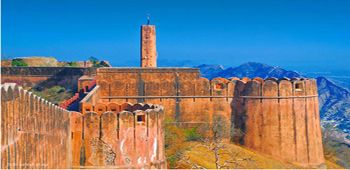 Jaigarh Fort or Fort of Victory is located 15 Km away from Jaipur in the Indian state of Rajasthan. It is considered to be one of the most well fortified structures in India. Jaigarh Fort Jaipur1The magnificent fort was constructed by Sawai Singh of Jaipur in 1726 in order to tighten the security of Amber and Jaipur. Situated on the top of the hill the fort provides the stunning view of the Jaipur town and magnificent amber fort. Jaigarh Fort or Fort of Victory is located 15 Km away from Jaipur in the Indian state of Rajasthan. It is considered to be one of the most well fortified structures in India. Jaigarh Fort Jaipur1The magnificent fort was constructed by Sawai Singh of Jaipur in 1726 in order to tighten the security of Amber and Jaipur. Situated on the top of the hill the fort provides the stunning view of the Jaipur town and magnificent amber fort. It was used as the treasury of the royal family of Jaipur. Jaigarh Fort is not that captivating as that of Amber Fort but it has its own charm that lures visitors.The main highlights of the fort are massive Cannon, fortification, museum, palaces, temples and the magnificent water tanks. Among all the major highlights Cannon is the prime attraction of the fort. It is believed to be the largest cannon in the world. It was strategically located so that it becomes easier to fire at the enemies or the attackers to the fort. |
|
Nahargarh Fort |
Top^ |
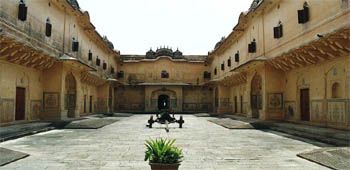 The Nahargarh Fort was built by Sawai Raja Jai Singh in 1734. Since Jaipur was his capital, the Nahargarh Fort was strategically important and was built as a means of bolstering the defense of Amer. It was also known as the Tiger Fort. New additions were made to the fort in the 19th century by Sawai Ram Singh II and Sawai Madho Singh II. The older parts of he fort are being hard hit by the ravages of times but the newer additions are quite captivating. The Nahargarh Fort was built by Sawai Raja Jai Singh in 1734. Since Jaipur was his capital, the Nahargarh Fort was strategically important and was built as a means of bolstering the defense of Amer. It was also known as the Tiger Fort. New additions were made to the fort in the 19th century by Sawai Ram Singh II and Sawai Madho Singh II. The older parts of he fort are being hard hit by the ravages of times but the newer additions are quite captivating.According to a legend, the Fort was named after a prince whose spirit used to haunt the site and would cause mischief so as to delay the construction of the fort. After too many disturbances, finally after a Tantrik prayer the ghost or the spirit, agreed to leave on the condition that the fort should be named after him. |
|
Rajmahal Palace |
Top^ |
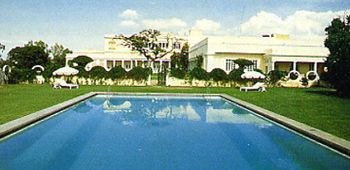 Rajmahal Palace Resort
is located at 170 kms from Jaipur on the Jaipur-Kota Road (Rajasthan,
India) offering facilities like Boating, Fishing, Sunbathing, Trekking,
Sightseeing etc
.A heritage property built in 1798 A.D., Rajmahal is a riverside resort
and a heritage hotel that is an ideal stopover on the Jaipur - Kota
Route for Luncheon as well as for overnight stopovers Rajmahal Palace Resort
is located at 170 kms from Jaipur on the Jaipur-Kota Road (Rajasthan,
India) offering facilities like Boating, Fishing, Sunbathing, Trekking,
Sightseeing etc
.A heritage property built in 1798 A.D., Rajmahal is a riverside resort
and a heritage hotel that is an ideal stopover on the Jaipur - Kota
Route for Luncheon as well as for overnight stopovers |
|
Jal Mahal Palace |
Top^ |
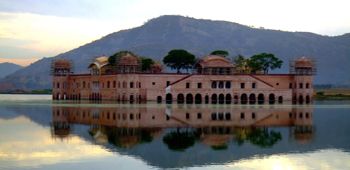 Jal Mahal of Jaipur is a pleasure palace built in the 18th century. Situated amidst the picturesque Mansagar Lake, the palace has the Nahargarh hills forming its backdrop. Jaipur Jal Mahal Palace is an architectural beauty and was meant to be used for the royal duck shooting parties. Developed as an enjoyment spot, it is entered through a causeway situated in the middle of Mansagar Lake. Jal Mahal of Jaipur, Rajasthan is a five-story palace, with the first four floors being submerged under water. The Nahargarh Fort situated nearby offers a splendid view of the lake as well as the palace. Jal Mahal of Jaipur is a pleasure palace built in the 18th century. Situated amidst the picturesque Mansagar Lake, the palace has the Nahargarh hills forming its backdrop. Jaipur Jal Mahal Palace is an architectural beauty and was meant to be used for the royal duck shooting parties. Developed as an enjoyment spot, it is entered through a causeway situated in the middle of Mansagar Lake. Jal Mahal of Jaipur, Rajasthan is a five-story palace, with the first four floors being submerged under water. The Nahargarh Fort situated nearby offers a splendid view of the lake as well as the palace. |
|
Hawa Mahal |
Top^ |
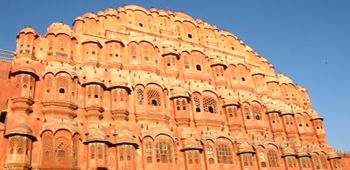 Hawa Mahal Hawa Mahal, or the "Palace of Winds", is a palace in Jaipur, India. It was built in 1799 by Maharaja Sawai Pratap Singh, and designed by Lal Chand Usta. It forms part of the City Palace and extends the Zenana or women's chambers, the chambers of the harem. Its original intention was to allow royal ladies to observe everyday life in the street below without being seen. Hawa Mahal Hawa Mahal, or the "Palace of Winds", is a palace in Jaipur, India. It was built in 1799 by Maharaja Sawai Pratap Singh, and designed by Lal Chand Usta. It forms part of the City Palace and extends the Zenana or women's chambers, the chambers of the harem. Its original intention was to allow royal ladies to observe everyday life in the street below without being seen.It has five stories and is constructed of red and pink sandstone, highlighted with white quick lime. The side facing the street outside the palace complex has 953 small windows, and the breeze (hawa) which circulates through these windows gives the palace its name, and keeps it cool even in hot months. The entrance opens onto a courtyard with a double-storied building on three sides, and one on the eastern wing with three more stories, which is just one room wide. There are no stairs to reach the upper floors, only ramps. |
|
Laxmi Narayan Temple |
Top^ |
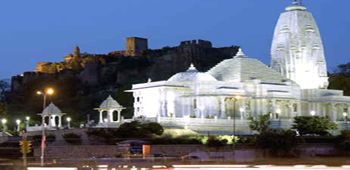 Birla Temple forms one of the major attractions of Jaipur. Birla Temple of Jaipur looks stunning, when it is brightly lit in the night. Birla Mandir, in pure white marble, dominates the skyline of southern part of Jaipur. The enormous temple was built during the year 1988, by Birla Group of Industries, one of the business tycoons of India. The Temple is dedicated to Lord Vishnu (Narayan), the preserver and his consort Lakshmi, the Goddess of wealth. Due to this reason, Birla Temple is also known as Laxmi Narayan Temple. Birla Temple forms one of the major attractions of Jaipur. Birla Temple of Jaipur looks stunning, when it is brightly lit in the night. Birla Mandir, in pure white marble, dominates the skyline of southern part of Jaipur. The enormous temple was built during the year 1988, by Birla Group of Industries, one of the business tycoons of India. The Temple is dedicated to Lord Vishnu (Narayan), the preserver and his consort Lakshmi, the Goddess of wealth. Due to this reason, Birla Temple is also known as Laxmi Narayan Temple.The Birla Mandir is situated just below the renowned Moti Dungri Fort. Built in a contemporary manner, Laxmi Narayan Mandir covers the vast lands of the city of Jaipur. The temple stands erect on a raised platform, at the footsteps of the Moti Dungri Hill. Birla Mandir is constructed in the finest quality of white marble. The three huge domes of the temple represent three different approaches to the religion. The beautiful white marble temple mesmerizes the onlookers, when it glows at night. |
|
Jantar Mantar |
Top^ |
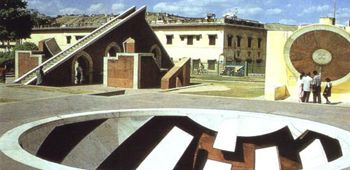 The Yantra Mandir (commonly known as the Jantar Mantar) is an equinoctial dial, consisting a gigantic triangular gnomon with the hypotenuse parallel to the Earth's axis. On either side of the gnomon is a quadrant of a circle, parallel to the plane of the equator. The instrument is intended to measure the time of day, correct to half a second, and declination of the Sun and the other heavenly bodies. The Yantra Mandir (commonly known as the Jantar Mantar) is an equinoctial dial, consisting a gigantic triangular gnomon with the hypotenuse parallel to the Earth's axis. On either side of the gnomon is a quadrant of a circle, parallel to the plane of the equator. The instrument is intended to measure the time of day, correct to half a second, and declination of the Sun and the other heavenly bodies.Maharaja Jai Singh II of Jaipur constructed four Yantra Mandirs in Delhi, Jaipur, Ujjain and Varanasi. |
|
govind devji temple |
Top^ |
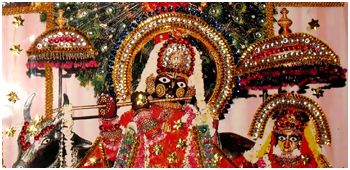 Govind Dev Ji Temple, is one amongst the major tourist attractions of Jaipur. The Temple
represents the royal past of Jaipur. The Temple is dedicated to Govind
Dev Ji (Other name of Lord Krishna). Govind Devji Temple of Jaipur is
situated in the City Palace complex, between the Chandra Mahal and Badal
Mahal. Govind Dev Ji is the principal deity of Amber's Kachawaha
Dynasty. In the earlier times, the idol of the lord used to reside in
the temple of Vrindavan in Uttar Pradesh.
According to a legend, Govind Dev Ji appeared in the dream of Raja Sawai
Jai Singh and asked him to bring his idol from Vrindavan to Jaipur. As a
consequence, Raja Sawai Jai Singh brought the idol and placed in the
City Palace complex of Jaipur. After the sad demise of Jai Singh, many
successors acquired the throne, but Raja Man Singh took the initiative
to build the temple in 1890. Govind Dev Ji Temple, is one amongst the major tourist attractions of Jaipur. The Temple
represents the royal past of Jaipur. The Temple is dedicated to Govind
Dev Ji (Other name of Lord Krishna). Govind Devji Temple of Jaipur is
situated in the City Palace complex, between the Chandra Mahal and Badal
Mahal. Govind Dev Ji is the principal deity of Amber's Kachawaha
Dynasty. In the earlier times, the idol of the lord used to reside in
the temple of Vrindavan in Uttar Pradesh.
According to a legend, Govind Dev Ji appeared in the dream of Raja Sawai
Jai Singh and asked him to bring his idol from Vrindavan to Jaipur. As a
consequence, Raja Sawai Jai Singh brought the idol and placed in the
City Palace complex of Jaipur. After the sad demise of Jai Singh, many
successors acquired the throne, but Raja Man Singh took the initiative
to build the temple in 1890. |
|
central museum |
Top^ |
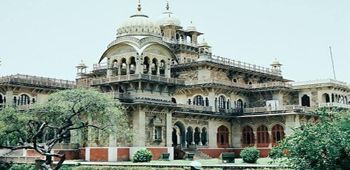 Central Museum, the oldest museum of the state with its extensive collection of archaeological and handicraft exhibits is housed in the stately building of Albert Hall, one of the finest examples of Indo-Saracenic architecture. Designed by Sir Swinton Jacob, the building was inaugurated in 1863 by Prince Albert and is known for its appropriate use of marble as well as sandstone. Central Museum, the oldest museum of the state with its extensive collection of archaeological and handicraft exhibits is housed in the stately building of Albert Hall, one of the finest examples of Indo-Saracenic architecture. Designed by Sir Swinton Jacob, the building was inaugurated in 1863 by Prince Albert and is known for its appropriate use of marble as well as sandstone.The Central museum was opened to public in 1887 and is now a State Museum of the state of Rajasthan. Located in the famous Ram Niwas Garden on the main Jawaharlal Nehru Marg, it has various sections like Paintings, Art and Industry, Carpets, Toys & Dolls, Armory and Textiles representing the culture, tradition, art, costumes and history of the region. |
|
bissau palace |
Top^ |
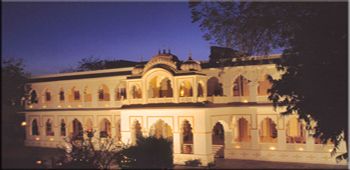 Bissau Palace, Jaipur
was built in the early 1920s by Rawal Raghubir Singhji. Built during
this time the palace was later turned into one of the heritage hotels of
Jaipur. Located away from the dust and grime of Jaipur city, the Bissau
Palace not only recalls the splendor of the bygone eras but even gives
the guests a serene royal retreat.Rajasthan's glorious past is preserved
in the walls of the Bissau Palace. Bissau Palace, Jaipur
was built in the early 1920s by Rawal Raghubir Singhji. Built during
this time the palace was later turned into one of the heritage hotels of
Jaipur. Located away from the dust and grime of Jaipur city, the Bissau
Palace not only recalls the splendor of the bygone eras but even gives
the guests a serene royal retreat.Rajasthan's glorious past is preserved
in the walls of the Bissau Palace. |
|
samode palace |
Top^ |
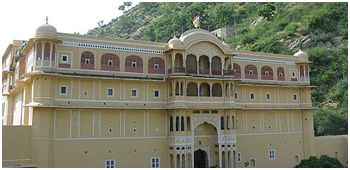 40 km from Jaipur, the fortified residence of the Nathawat family is a charming and romantic citadel that exhibits grandeur, good taste, class and elegance worthy of the erstwhile Prime Ministers of the Jaipur Royal Court. The main entrance of the fort is through the village and one can opt for camel safari to ride across the village with hardy desert people flashing warm smiles and extending cordial hospitality. The medieval architecture of the fort reflects oriental formality. 43 spacious rooms and suites surround the centrally located open courtyards and boast of their very own having private balconies and views. 40 km from Jaipur, the fortified residence of the Nathawat family is a charming and romantic citadel that exhibits grandeur, good taste, class and elegance worthy of the erstwhile Prime Ministers of the Jaipur Royal Court. The main entrance of the fort is through the village and one can opt for camel safari to ride across the village with hardy desert people flashing warm smiles and extending cordial hospitality. The medieval architecture of the fort reflects oriental formality. 43 spacious rooms and suites surround the centrally located open courtyards and boast of their very own having private balconies and views. |
|
albert museum |
Top^ |
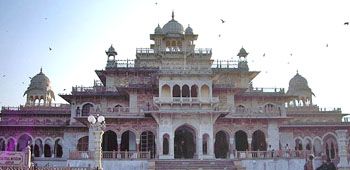 Albert museum, is one of the oldest museum of the state. Colonel Sir Swinton Jacob
designed it in 1876 to greet King Edward VII as Prince of Wales on his
visit to India. It was opened to public ten years later. Positioned
amidst the gardens of Ram Niwas Bagh in Jaipur, this museum has an
assortment of rare articles on its display including textiles, carpets,
paintings, metal and wood crafts, pottery, arms and weapons, flora and
fauna of the state, toys, dolls and even an Egyptian mummy that belongs
to the Ptolemaic Epoch. It is also known for housing the famous carpet,
which portrays the scene of a Persian garden carpet with running water
streams that was bought at a dear price from Shah Abbas of Persia, by
Mirza Raja Jai Singh I. It also puts on show the miniature paintings of a
number of sub-schools of Rajasthan. Albert museum, is one of the oldest museum of the state. Colonel Sir Swinton Jacob
designed it in 1876 to greet King Edward VII as Prince of Wales on his
visit to India. It was opened to public ten years later. Positioned
amidst the gardens of Ram Niwas Bagh in Jaipur, this museum has an
assortment of rare articles on its display including textiles, carpets,
paintings, metal and wood crafts, pottery, arms and weapons, flora and
fauna of the state, toys, dolls and even an Egyptian mummy that belongs
to the Ptolemaic Epoch. It is also known for housing the famous carpet,
which portrays the scene of a Persian garden carpet with running water
streams that was bought at a dear price from Shah Abbas of Persia, by
Mirza Raja Jai Singh I. It also puts on show the miniature paintings of a
number of sub-schools of Rajasthan. |
|
narain niwas palace |
Top^ |
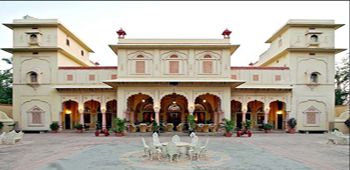 Narain Niwas, was built in the 1928 by General Amar Singh, Thakur of Kanota,
Commander of the Jaipur State Forces and confident of the then Maharaja,
Sawai Man Singh. General Amar Singh was the grandson of Thakur Zorawar
Singh, founder of the Kanota family. Thakur Shivnath Singh, (General
Amar Singhji's brother) supervised the actual construction. The new
mansion was named after their father, Thakur Narain Singh, who had been
Chief of police in Jaipur State as well as a minister at the
neighbouring princely state of Alwar. Narain Niwas, was built in the 1928 by General Amar Singh, Thakur of Kanota,
Commander of the Jaipur State Forces and confident of the then Maharaja,
Sawai Man Singh. General Amar Singh was the grandson of Thakur Zorawar
Singh, founder of the Kanota family. Thakur Shivnath Singh, (General
Amar Singhji's brother) supervised the actual construction. The new
mansion was named after their father, Thakur Narain Singh, who had been
Chief of police in Jaipur State as well as a minister at the
neighbouring princely state of Alwar. |
|
kanak valley |
Top^ |
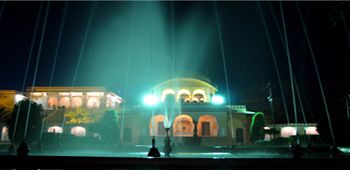 The Kanak Valley, formed by the Aravali ranges adjoins the town of Amber and stretches
towards the historical city of Jaipur. The hills and valleys are covered
with dhok (Anogeissus Pendula) and kadamba tree. Traveling deeper into
the valley one comes across numerous waterfalls, lotus ponds and
flowering plants. In summer when the 'flame of the forest' bursts into
bloom, it seems as if the entire forest is aflame. Migratory birds like
the kingfisher, spotted dove and neelkanth are frequent visitors. The Kanak Valley, formed by the Aravali ranges adjoins the town of Amber and stretches
towards the historical city of Jaipur. The hills and valleys are covered
with dhok (Anogeissus Pendula) and kadamba tree. Traveling deeper into
the valley one comes across numerous waterfalls, lotus ponds and
flowering plants. In summer when the 'flame of the forest' bursts into
bloom, it seems as if the entire forest is aflame. Migratory birds like
the kingfisher, spotted dove and neelkanth are frequent visitors.This is a perfect surrounding for the temples that have been standing here for three centuries. The temple complex consists of the temple of Govind Deoji and Natawarji besides a garden known as the Kanak Bagh. They temple site is such that the Valley stretches out on one side and the river Dharbawati on the other. This river used to flow across the city of Jaipur but today it has diminished into the lake, Mansagar. This used to be the scared spot where holy water from several rivers was accumulated for the performance of the Ashwamedh yagna. |
|
Cenotaphs of Gaitore |
Top^ |
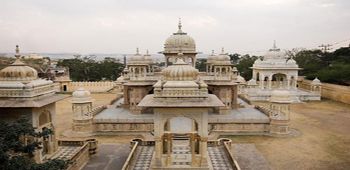 Gaitore, is situated on the Jaipur-Amber road, about 15 kms from Jaipur. Gaitore
is a royal cremation site of the majestic rulers of Jaipur. There is a
cenotaph for each Maharaja, built in his honor. These royal cenotaphs of
the Maharajas are commonly known as 'Chhatris'. The royal chhatris are
engraved with typical Rajasthani carvings. Gaitore is regarded to be the
mispronounced form of a Hindi phrase 'Gaye ka Thor' which means
'resting place of the departed souls'. Gaitore, is situated on the Jaipur-Amber road, about 15 kms from Jaipur. Gaitore
is a royal cremation site of the majestic rulers of Jaipur. There is a
cenotaph for each Maharaja, built in his honor. These royal cenotaphs of
the Maharajas are commonly known as 'Chhatris'. The royal chhatris are
engraved with typical Rajasthani carvings. Gaitore is regarded to be the
mispronounced form of a Hindi phrase 'Gaye ka Thor' which means
'resting place of the departed souls'.
The cenotaphs are erected with a perfect blend of architectural essentials of Islamic tomb architecture and Hindu temple architecture. Amongst all the cenotaphs, the one dedicated to Maharaja Sawai Jai Singh II appeals the most. This Chhatri is built in pure white marble, ornamented with delicate carvings, peacocks and beautiful designs. Although all the Maharajas of Jaipur were cremated here, but Maharaja Sawai Ishwari Singh was an exception to this ritual. He was cremated behind the Chandra Mahal in the City Palace complex, so his cenotaph was built there with the due respect. |
|
rambagh palace |
Top^ |
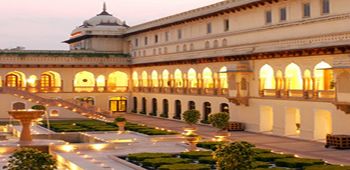 Rambagh Palace, has been home to generations of royals. Built in 1835 on a modest scale
for the queen's favourite handmaiden Kesar Badaran, it was later
refurbished as a royal guesthouse and hunting lodge. In 1925, Rambagh
was converted into a palace, and became the residence of the Maharaja of
Jaipur.
The 'Jewel of Jaipur' as it is fondly called, remained the home of the
Jaipur royal family until 1957, when it was first converted into a
luxury hotel by Maharaja Sawai Man Singh II. But it wasn't until 1972
that Taj Hotels Resorts and Palaces took over the reins. It is now the
'jewel in the crown' among the authentic palaces of the Taj in India. Rambagh Palace, has been home to generations of royals. Built in 1835 on a modest scale
for the queen's favourite handmaiden Kesar Badaran, it was later
refurbished as a royal guesthouse and hunting lodge. In 1925, Rambagh
was converted into a palace, and became the residence of the Maharaja of
Jaipur.
The 'Jewel of Jaipur' as it is fondly called, remained the home of the
Jaipur royal family until 1957, when it was first converted into a
luxury hotel by Maharaja Sawai Man Singh II. But it wasn't until 1972
that Taj Hotels Resorts and Palaces took over the reins. It is now the
'jewel in the crown' among the authentic palaces of the Taj in India. |
|
City Palace |
Top^ |
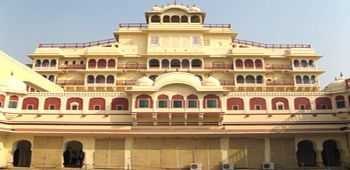 The City Palace is an imposing blend of traditional Rajasthani and Mughal art and architecture. The City Palace is an imposing blend of traditional Rajasthani and Mughal art and architecture.The City Palace complex houses several palatial structures. The first building in it is Mubarak Mahal, built by Maharaja Madho Singh. It has a beautifully carved marble gate with heavy brass doors on either side of this gate. Beyond this gate lies the Diwan -e-Khas, or the "Hall of Private Audience. The palace is now a fine museum and houses a remarkable collection of textiles , paintings, manuscripts, and extraordinary weapons. On display are two huge urns of silver, said to be the largest silver vessels in the world. Nakkarkhana-ka-Darwaza, the imposing gateway of the City Palace guarded by stone elephants, is monumental. |
|
galtaji temple |
Top^ |
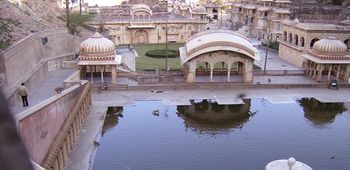 Galtaji is an ancient Hindu pilgrimage site situated 10 km from Jaipur in Indian state of Rajasthan on Jaipur-Agra highway near Sisodia Rani Ka Bagh .There are temples, pavilions, natural springs and holy 'kunds'. Galtaji is an ancient Hindu pilgrimage site situated 10 km from Jaipur in Indian state of Rajasthan on Jaipur-Agra highway near Sisodia Rani Ka Bagh .There are temples, pavilions, natural springs and holy 'kunds'.It is believed that Saint Galav spent his life here and did meditation. The main temple here is temple of Galtaji in pink stone and has a huge complex. The temple has a number of pavilions with rounded roofs, exquisitely carved pillars and painted walls. The temple is surrounded by natural springs and reservoirs that are considered holy .There are seven tanks here and the Galta Kund is considered the holiest. A large number of people take a holy bath in these tanks especially on Makar Sankranti. |
|
Sisodia Rani Ka Bagh |
Top^ |
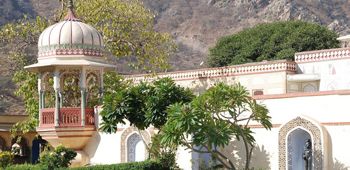 The Sisodia Rani ka Bagh was built for Sawai Jai Singh's wife, Sisodia Queen who was from Udaipur. The garden is located on the Jaipur-Agra Road and is about 10 kms from Jaipur. The Sisodia Rani ka Bagh was built for Sawai Jai Singh's wife, Sisodia Queen who was from Udaipur. The garden is located on the Jaipur-Agra Road and is about 10 kms from Jaipur.The Garden is laid out in the Mughal style and is a tiered multi-level garden, which has fountains, water channels and many painted pavilions. The garden was the perfect place for the queen to enjoy the beautiful landscape, cool breeze and fresh air. Many say, the garden was built as a cure to the Queen's homesickness but some insist the Queen found the gardens to be the perfect place to escape Court intrigues. |
|